Paris Field Notes: Finding Olympia
The real block, the imagined block, and the café that kept returning
A city changes when you walk it.
On a map, Paris can look orderly: boulevards, axes, monuments, arrondissements, transit lines, polite geometry. But at street level, the city becomes something else. It compresses. It folds. A doorway becomes a clue. A narrow passage becomes a plot device. A café window becomes a surveillance post, a refuge, a stage, or a trap.
That is how Olympia became real to me.
The Olympia of Les Boulevardiers is fictional, but it is not invented from nothing. It is rooted in the area around the Palais Garnier, Rue Édouard VII, Rue Caumartin, Boulevard des Capucines, and the real Olympia theater district. In the book, I expanded and intensified the block. I made it denser, more populated, more layered, more socially combustible. I treated the neighborhood less like a single location and more like a living mechanism.
Olympia needed to feel like a place where everyone might cross paths.
A dancer.
A Sûreté inspector.
A gambler.
A courtesan.
A hotelier’s son.
A smuggler.
A mystic.
A gentleman pretending not to be desperate.
A criminal pretending to be a gentleman.
That density matters.
In the real Paris, neighborhoods do not behave like flat backdrops. They stack lives vertically. Shops at street level. Apartments above. Service spaces behind. Courtyards hidden from view. Passages connecting one building to another. Wealth facing the boulevard. Labor entering through the back. Secrets moving through the seams.
For Les Boulevardiers, I took that logic and turned the dial.
Olympia became a compact urban ecosystem: theater, hotel, café, maison de luxe, private club, opium den, esoteric society, back passages, service entries, rooftops, alleys, and rooms above rooms above rooms. In the novel, the district is introduced as one of the brightest jewels of Paris, but also as a wilder, darker place where theaters, clubs, casinos, dance halls, brothels, opium dens, science, superstition, class, and danger all converge.
That is the version of Paris I wanted: not postcard Paris, but threshold Paris.
Why the field notes matter
The Paris images matter because they are not just reference material. They are reminders of texture.
Rain on limestone.
A narrow street after dark.
The glow from a café interior.
The authority of a theater façade.
The melancholy of a service entrance.
The way a building seems respectable from one angle and conspiratorial from another.
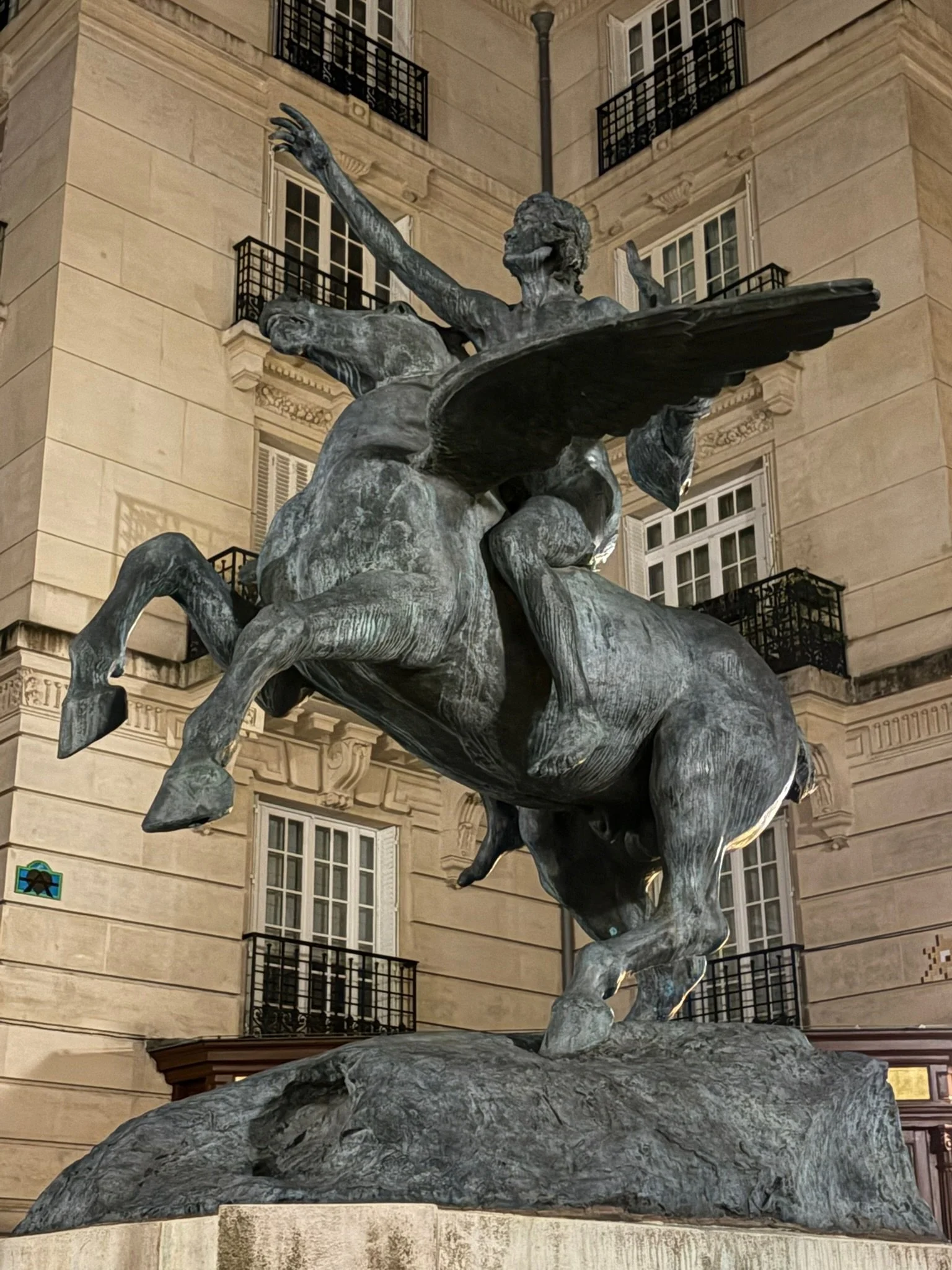
Those details are not decorative. They influence plot.
A slick cobblestone changes how a carriage moves. A café window changes what an inspector can see. A narrow passage changes who can escape. A dense block changes how secrets travel. A public room changes how private grief is performed.
That is why Olympia had to be more than a setting.
It had to become a device.
A place that produces story.
The imagined city inside the real one
I do not think of the Olympia in Les Boulevardiers as an alternate Paris so much as a compressed Paris. A heightened Paris. The kind of Paris that might exist if every rumor were true, every doorway mattered, and every glittering room had a second life after midnight.
Les Bacchantes remains one of my favorite anchors because it resists spectacle. It is not the most decadent room. It is not the most dangerous. It is not the most secret.
It is the place where the neighborhood keeps talking.
And in Olympia, that may make it one of the most important places of all.
